QTI & Standards
PIE integrates with established assessment standards through dedicated tooling and QTI-inspired architectural patterns.
PIE-QTI
PIE-QTI is a sibling project that provides production-ready QTI item and assessment players alongside a version-agnostic architecture supporting both QTI 2.x and QTI 3.0. It also includes bidirectional transform tooling for converting between QTI and PIE formats.
21
Interaction types
45+
Response processing operators
65-70%
Code reuse across QTI versions
8
Supported locales
Version-Agnostic Architecture
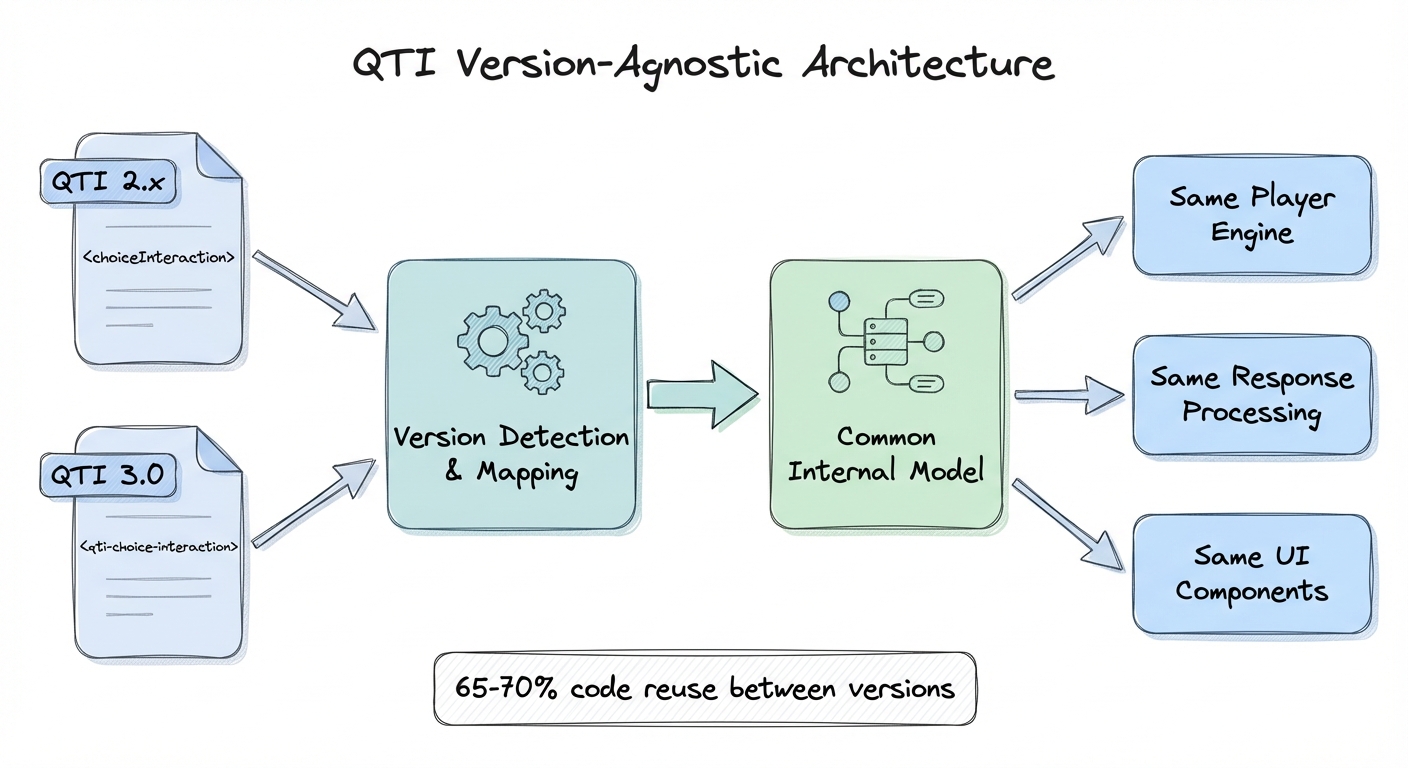
PIE-QTI auto-detects QTI version from XML and maps both QTI 2.x and QTI 3.0 content to a common internal model. This achieves 65-70% code reuse between versions.
| Aspect | QTI 2.x | QTI 3.0 |
|---|---|---|
| Element names | choiceInteraction | qti-choice-interaction |
| Attribute names | responseIdentifier | response-identifier |
| Root element | <assessmentItem> | <qti-assessment-item> |
| Convention | camelCase | kebab-case with qti- prefix |
Auto-Detection
Version detection from namespace URI, root element name, and version attribute. Supports QTI 2.0, 2.1, 2.2, and 3.0.
Element Mappers
Qti2ElementNameMapper and Qti3ElementNameMapper convert version-specific names to a shared canonical form, e.g., choiceinteraction.
172 Element Mappings
QTI 3.0 element mapping covers 172 elements with corresponding attribute name mappings for full specification coverage.
Bidirectional Transforms
Organizations with existing QTI content can import it into PIE, and PIE content can be exported to QTI. The transform engine is plugin-based and extensible.
QTI → PIE
Transform QTI 2.x and 3.0 XML into PIE JSON format. Auto-detected version, plugin-based extraction of interactions, response declarations, and processing rules.
PIE → QTI
Export PIE items to QTI 2.2 XML format. Generates valid QTI with response declarations, outcome declarations, and response processing.
Tooling
CLI for batch transforms, a web application for upload/analyze/transform/preview workflows, and IMS Content Package support for standards-compliant exchange.
QTI 3.0 Influence on PIE
QTI 3.0 concepts directly inspired several PIE architectural features, making content naturally mappable between the two ecosystems.
Personal Needs Profiles (PNP)
PIE's assessment toolkit uses QTI 3.0 Personal Needs Profiles for accommodation resolution. The PNPToolResolver maps student accommodation profiles to PIE tool IDs using a multi-layer precedence hierarchy.
Accessibility Catalogs
The AccessibilityCatalogResolver uses QTI 3.0-inspired catalogs for alternative content: pre-recorded audio, sign language videos, braille alternatives, with priority ordering at item and assessment levels.
Section & Assessment Models
PIE's assessment definitions use QTI-inspired structures: test parts containing sections, sections containing assessment item references, rubric blocks for stimulus and instructions, and nested section support.
Context Declarations
QTI 3.0's context declarations for cross-item shared state are supported in PIE's assessment entity model, enabling shared data across items within an assessment.
Other Standards
LTI (Learning Tools Interoperability)
LTI support is planned as an upcoming addition to pie-players, enabling PIE-based assessments to be embedded as LTI tools within LMS platforms like Canvas, Moodle, and Blackboard.
Planned