Docs: Integration
Integration
PIE renders and runs assessment content in the browser. The host application owns the content, the learner record and the policy around them, and assembles its player from PIE's building blocks in one of four patterns.
Integration patterns
Item player with toolkit
<pie-assessment-toolkit> around a <pie-item-scope> per item, with <pie-item-toolbar>
Items rendered one at a time, with tools and accommodations.
Section player
A layout element with runtime and section
A section screen: passages, items, section tools, section session.
Custom assessment player
Section players, one coordinator per assessment, the assessment-session helpers
Multi-section delivery with the host's routing, persistence and submission.
Authoring (mode="author") and print (<pie-print>) use the item
player and the print player on their own; Players covers both.
Item player with toolkit
<pie-assessment-toolkit> needs no section. Each <pie-item-scope> registers its item and the item's settings with the
coordinator the toolkit builds from its properties; the toolbar inside the scope renders the
placed tools, and the tools act on the scope's [data-region="content"]. The item
player's events pass through the scope unchanged, and the session stays the item player's.
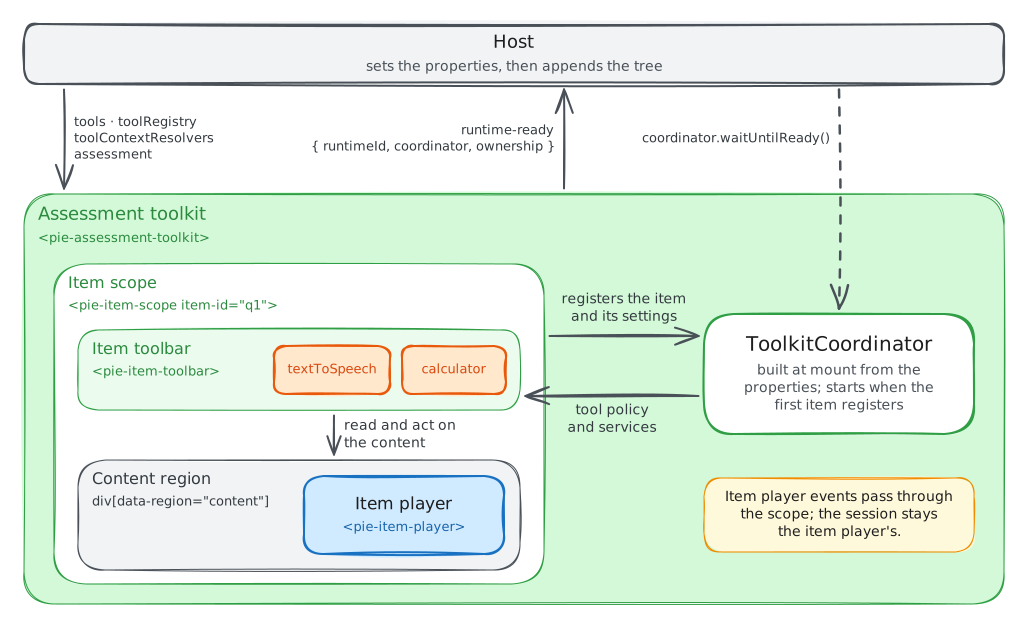
The first scope that registers starts the coordinator from the toolkit's inputs at that moment. runtime-ready carries the coordinator once it exists, and coordinator.waitUntilReady() resolves once saved tool state has loaded and
text-to-speech has started, unless it starts lazily. toolkit-ready and section-ready belong to a bound section
and do not fire here.
Custom assessment player
A custom assessment player mounts a section player per section with one coordinator for the
whole assessment, keeps the attempt in an AssessmentSession, and persists through
the coordinator's hooks against the host's backend. Construct a coordinator when the host needs
the services directly; otherwise the section player builds one from runtime.tools.
Coordinator hooks exist only on a host-built coordinator, because they must be in place before
the first section controller exists.
A coordinator the host passes stays the host's: a layout disposes only a coordinator it built.
The coordinator's subscribeItemEvents and subscribeSectionLifecycleEvents follow the active section across navigation. createNewAssessmentSession, upsertSectionSession and setCurrentSectionPosition keep the section
sessions and the current position in the attempt, which the host stores.
The reference assessment player assembles this pattern from the same public exports, with
navigation, a cancelable assessment-navigation-requested event and submission; read
it as a pattern for a host's own player.
Assessment player README(opens in new tab) · Reference assessment player
What PIE and the host own
The players and the toolkit run the assessment in the browser; the host owns durable data and
policy. The host stores what the players report, through session-changed, getSession() and the persistence hooks, and decides navigation between sections.
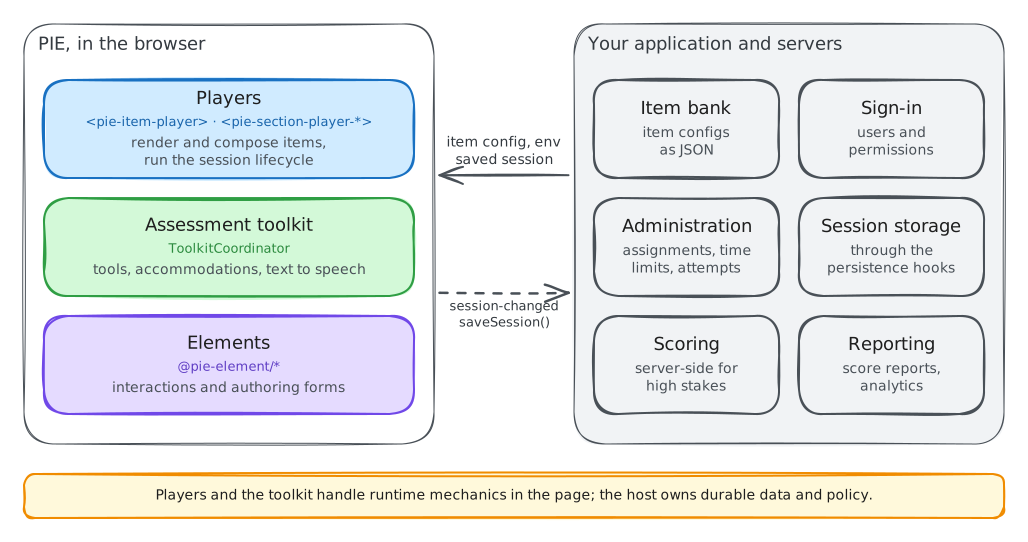
PIE
- Rendering: items, passages and rubrics with their layout, styling and behavior
- Composition: items, passages and tools composed into section layouts
- Interaction: learner responses captured through accessible interfaces
- Authoring: each element's configuration UI
- Accessibility: the WCAG 2.2 AA target, keyboard support, screen reader compatibility
- Tools and accommodations: calculators, text-to-speech, annotation, color schemes, tool policy
- Session lifecycle: hydration, persistence through host strategies, and session change events
The host
- Item storage: the item bank or CMS that stores item configs as JSON
- Authentication and authorization: users, permissions, sign-in
- Assessment administration: assignments, time limits, attempt counts
- Session storage: the sessions the players report, stored through the persistence hooks or from session-changed
- Scoring: for graded delivery, the element controllers run on your server under hosted delivery
- Reporting: score reports and analytics
Controller API
Players are custom elements and work in any framework. Object inputs — config, runtime, section, session, toolRegistry — are
set as JS properties; attributes carry strings.
The layouts' DOM events — pie-stage-change, pie-loading-complete, toolkit-ready, framework-error, session-changed, composition-changed — are the lifecycle contract. In-section change arrives through
the SectionController's typed subscribe() stream, or through the coordinator's subscribeItemEvents and subscribeSectionLifecycleEvents, which follow the
active section across navigation.
waitForSectionController(timeoutMs) resolves with the controller, or null at the timeout; getSectionController() returns null while the controller is pending. hydrate() reloads from the persistence strategy on
demand, and getSession() is the snapshot to store. Persistence strategies implement loadSession(ctx), saveSession(ctx, session) and optionally clearSession(ctx), keyed by assessment, section and attempt.
subscribe() stream and getSession().Section player integration guide(opens in new tab) · Section player README(opens in new tab)
Delivery and scoring
By default the whole item config reaches the browser, answer keys included, and the element controllers run there. That fits practice and formative delivery. Graded delivery runs the controllers on a server instead; Security sets out what it takes.
Delivery backend
A delivery backend answers four operations: load, saveSession, model and score. The built-in client speaks the PIE API service's player
routes; a host with another backend supplies its own client. The section player
configures it once in its runtime
and derives each embedded item player's backend from it; a hosted player cannot score in the
browser, so formative delivery needs an unhosted one.
Element controllers
model(question, session, env, updateSession) turns the authored model into the view
model an element renders. outcome(model, session, env) resolves to { score, empty } with a score from 0 to 1; feedback and correctness reach the
learner through model() in evaluate mode.
env carries mode (gather collects responses, view shows them read-only, evaluate shows correctness and feedback) and role (student or instructor); controllers also read lockChoiceOrder and partialScoring.
Where the controller runs · Security(opens in new tab) · Element contract(opens in new tab)