Guide and reference
Scoring and rubrics
Score responses in the browser or on a server, with partial credit and rubrics.
From the pie-players documentation · View source(opens in new tab)
How an item rendered by <pie-item-player> gets a score, for hosts deciding
where to score: in the browser with provideScore(), or on the server with
score(). Each PIE element scores its own response through its controller's
outcome(model, session, env), and the item player returns those outcomes
without rolling them into an item score. Server scoring also covers saved
sessions, manual scores and rubric items. The design history behind these
choices is in scoring design notes.
Scoring Paths
| Comparison | provideScore() |
score() |
|---|---|---|
| Runs | Each element controller's outcome() in the browser |
On the backend, through backend.delivery (backend support) |
| Needs | A player that is not hosted, with controllers loaded: a client-player.js bundle under iife, the controller modules esm loads, or a controller registered with registerPreloadedElements |
An enabled backend.delivery |
| Returns | One slot per model, in config.models order; false when the item has no models |
What the backend's scoring contract returns; the PIE API service returns { max, points, partialScoring, type } |
| Records | Nothing | On the PIE API service, the session's data and its score |
provideScore() calls outcome() with the player's env, mode set to
"evaluate". Each slot is the element's session row merged with its outcome
(score, max, empty and whatever else the element returns), or undefined
when the model has no rendered element or its controller has no outcome(). A
hosted player loads no controllers, so its provideScore() returns an
undefined slot per model; that includes a player with backend.delivery
enabled and hosted unset.
A browser that holds the controllers holds the answer key, so a learner-facing
score that must be trusted comes from score()
(delivery integrity).
Items, Sessions and Controllers
An item config maps tags to packages and holds one authored model per element instance:
{
  markup: "<multiple-choice id=\"mc1\"></multiple-choice>",
  elements: {
    "multiple-choice": "@pie-element/multiple-choice@14.0.3"
  },
  models: [
    { id: "mc1", element: "multiple-choice", ... }
  ]
}
The session is an item-level container with one row per element instance:
{
  id: "session-id",
  data: [
    { id: "mc1", element: "multiple-choice", value: ["choice-a"] },
    { id: "match1", element: "match", answers: [...] }
  ]
}
The id ties the authored model, the rendered custom element and the session
row together. The response shape inside a row belongs to the element: value,
answers, selectedTokens, a nested partA / partB, and so on.
A controller exposes:
model(model, session, env, updateSession?), which builds the delivery model.outcome(model, session, env), which evaluates a response.createCorrectResponseSession(model, env), for instructor preview.validate(model, config), for authoring validation.
Some controller type definitions also declare a score() function; neither path
calls it.
Multi-Element Items
A multi-element item has several config.models entries and several session
rows. provideScore() returns one outcome per model and leaves the item score
to the host, which defines the aggregation rule explicitly. The PIE API service
aggregates by default as Persisted API Scoring
describes. Section-level formative delivery aggregates by the same policy and
records a four-valued correctness instead of a score
(formative delivery contract).
Persisted API Scoring
The PIE API service scores a saved session.
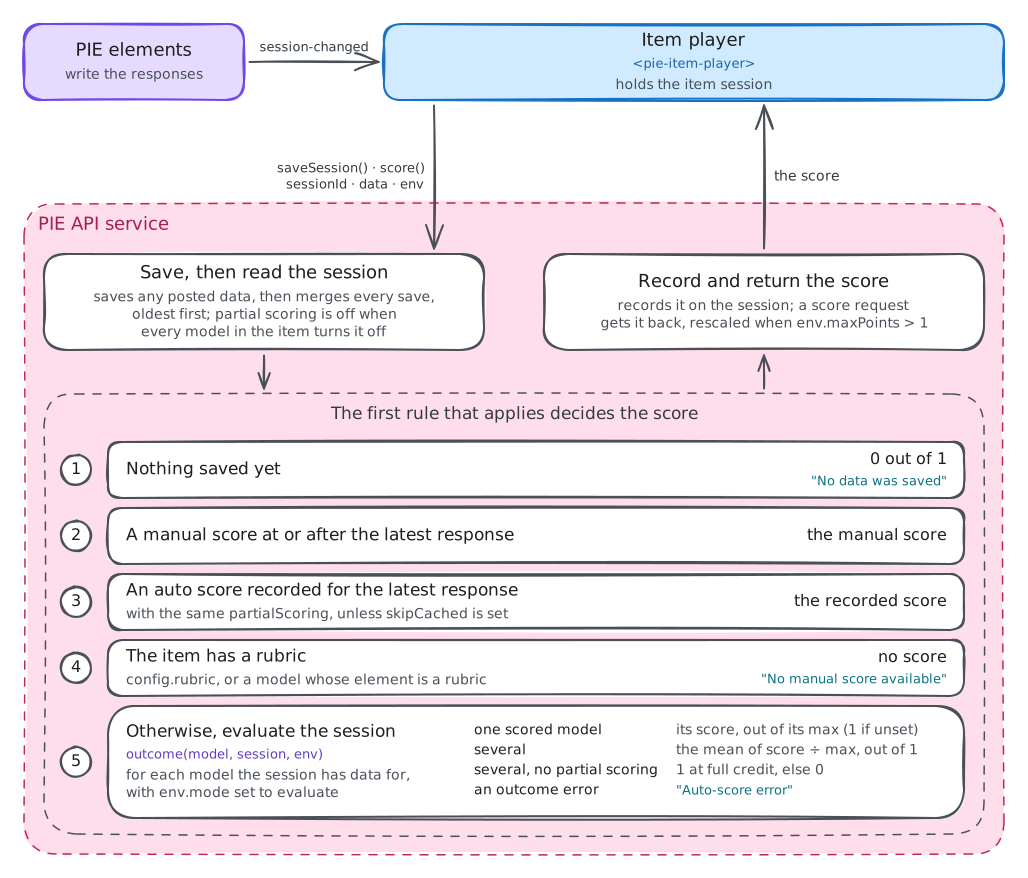
A save request and a score request take the same path:
- The posted
datais saved as a session event. - The session's save events are merged, oldest first, into its current
session.data. - When every model in the item has
partialScoring: false, the service setsenv.partialScoringtofalse.
The first of these rules that applies decides the score:
- No save:
{ points: 0, max: 1, type: "auto" }with the message"No data was saved". - A manual score given at or after the latest save is returned as is, with
type: "manual". - The auto score recorded for the latest save is returned when its
partialScoringmatches the request's, unless the request setsskipCached: true. - A rubric item, one whose config has a
rubricor a model whose element name containsrubric, gets no auto score: the result carries only the message"No manual score available". - Otherwise the service sets
env.modeto"evaluate"and calls each element controller'soutcome(model, sessionRow, env). An outcome carrying an error makes the result the message"Auto-score error"with the errors.
Outcomes without a score do not count. By default the counted outcomes
aggregate as:
| Counted outcomes | points |
max |
|---|---|---|
| One | its score |
its max, or 1 |
| Several, partial scoring on | the mean of score / max |
1 |
| Several, partial scoring off | 1 when that mean is exactly 1, otherwise 0 |
1 |
Example: two auto-scored elements, one with full credit and one with none:
// partialScoring: true
{ points: 0.5, max: 1, type: "auto" }

// partialScoring: false
{ points: 0, max: 1, type: "auto" }
The service records the score. A score request returns it, rescaled when
env.maxPoints is above 1: points becomes round(points / max * maxPoints)
and max becomes maxPoints. env.partialScoring defaults to true on the
service.
EBSR
The two-part selected-response element is @pie-element/ebsr, spelled EBSR
throughout PIE. It renders two multiple-choice-like parts as one PIE model and
one custom element, with a nested session:
{
  id: "ebsr1",
  element: "ebsr",
  value: {
    partA: { id: "partA", value: ["..."] },
    partB: { id: "partB", value: ["..."] }
  }
}
The controller scores each part and returns one outcome for the whole model.
| Partial scoring | max |
Score |
|---|---|---|
| Off | 1 | 1 only when Part A and Part B are both fully correct, otherwise 0 |
| On | 2 | Part A gates all credit: both correct 2; Part A correct and Part B not fully correct 1; Part A not fully correct 0, whatever Part B holds |
A generic two-element item aggregates differently; EBSR's rule lives inside its controller and is its scoring contract.
Rubric and Manual Scoring
Rubric elements describe manual scoring criteria and their visibility; they do not score a learner's response.
- Simple rubric: exposes
model()andvalidate(). Instructors receive the normalized rubric model and students an empty one. It validates point descriptors and has no meaningfuloutcome(). - Multi-trait rubric: prepares scale and trait display data and controls
whether students see the rubric. Its scoring functions are stubs:
getScore()returns0andoutcome()returns{ score: 0, empty: true }. - Complex rubric: wraps
simpleRubric,multiTraitRubricandrubricless, switching model shape and visibility onrubricType. Its scoring is the same stub.
The PIE API service treats a whole item as a rubric item when its config has a
rubric or any model's element name contains rubric, and scores it only
manually (rule 4 above).
Partial Scoring
Most element controllers decide partial scoring with a shared rule:
model.partialScoring === falseturns it off.env.partialScoring === falseturns it off.- Otherwise it takes the element's own default, or
truewhen the element sets none.
Element rules still differ: multiple-choice in radio mode is dichotomous, EBSR
gates on Part A, and elements that need manual scoring return 0. On the PIE
API service the item-wide switch in step 3 of the scoring path runs before any
rule.
Practical Guidance
- Persisted learner attempts: score on the server with
score(). The PIE API service accounts for save events, manual scores, cached auto scores, rubric items and the partial-scoring mode. - Local demos and previews: call
provideScore()for per-element outcomes from the browser, or call an element'soutcome()directly. - Multi-element items: the item player does not sum scores; define the aggregation rule.
- EBSR: score it as one element. Splitting Part A and Part B into item-level aggregation breaks its contract.
- Rubric, multi-trait-rubric, complex-rubric, drawing-response and similar manually scored interactions: expect a manual score.