Docs: Timed media
Timed media
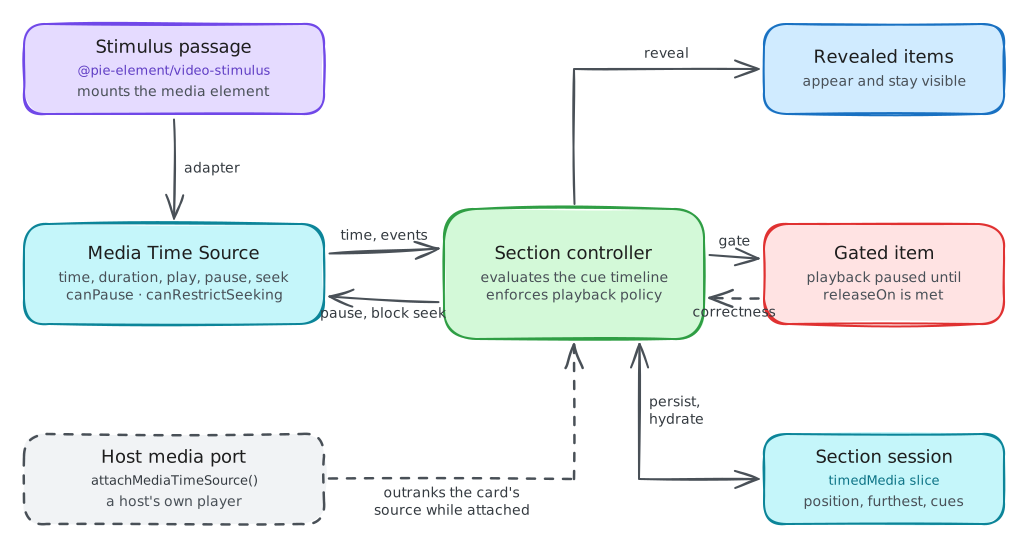
A timed-media section pairs a video or audio stimulus with a cue timeline. As the media plays, cues reveal items, pause playback until the learner answers, or record that a moment was reached. It is a section type, so it renders in the section player layouts you already use.
How it fits together
The stimulus
An ordinary passage with class stimulus. Its content mounts the media, usually @pie-element/video-stimulus; its accessibility catalogs carry the transcript and
signed alternates.
The timeline
timedMedia.cues names time ranges and the items each one acts on. Items no cue
reveals or gates are delivered as usual.
The layouts
Splitpane, vertical, tabbed and kernel-host layouts all render it. Without sectionType: "timed-media" a section behaves exactly as before.
A cued section
At 42.5 seconds the video pauses on q1 and resumes only once it is answered
correctly; at 118 seconds q2 appears without stopping playback.
Cue activation
| Activation | When the cue fires |
|---|---|
reveal | Its items appear and stay visible. Reveals never retract, even after a seek backwards. |
gate | Its items appear and playback pauses until every one satisfies releaseOn, such as "correct". A gate never resumes playback on its own, and seeking past it still
trips it. onUnknownCorrectness decides what an item that cannot report correctness
does. |
metadata | Records that the moment was reached and reveals nothing. |
To split must-answer items from optional ones at the same moment, author two cues at one
timestamp: a gate over the first set and a reveal over the second. A gate on correctness reads
the result of formative delivery(opens in new tab), so the section
needs maxTries: "unlimited"; with a finite budget a learner could exhaust their tries
and never release playback.
Playback policy
| Field | Default | Effect |
|---|---|---|
allowSeekAhead | false | The learner cannot seek past the furthest position reached, including across a reload. |
pauseOnRequiredCue | true | Playback pauses when a gate activates. |
requireMediaCompletion | false | The section is complete only once the media has played to the end. |
scoringPolicy.strategy (sum-child-outcomes, average-child-outcomes or host-defined) is validated and carried with the
section. PIE derives no aggregate score from it; the host does.
Media Time Source
The section reaches media only through a Media Time Source: current time, duration, play, pause,
seek and events, plus two capabilities, canPause and canRestrictSeeking.
The stimulus card attaches one for the media element its passage mounted. A host with its own
player, a third-party video service for instance, implements the same interface from @pie-players/pie-players-shared/timed-media and attaches it.
canPause: false or canRestrictSeeking: false, the
matching policy becomes advisory: cues still fire and state is still recorded, the projection
reports enforcement: "advisory", and a recoverable timed-media framework
warning names the policy that cannot be enforced.Session and errors
Cue state persists in the section session as a versioned timedMedia slice: the media
position, the furthest position reached, whether the media completed, visited and completed cues,
and the active cue. It hydrates with the rest of the snapshot, so a reload resumes at the same
gate. A slice with an unknown version is rejected whole. A cued item is mounted and hidden until
its cue fires, so its session survives seeking.
Three authoring mistakes fail loudly with a timed-media framework error, after which
the section delivers as an ordinary section with every item visible: a stimulusRef that resolves to nothing, a stimulus that mounts no media, and a correctness gate over an item
without unlimited tries.
Accessibility
- Cue activations are announced, and focus moves to a gated item when playback pauses on it.
- Captions and the transcript stay available throughout; signed video rides on the stimulus's catalogs.
- Read-aloud and media audio never play at once, and the learner's latest action wins: starting read-aloud pauses the media, starting the media stops read-aloud. Neither resumes what it silenced.
Accessibility covers read-aloud and catalogs.
Status
The section contract and runtime are implemented. @pie-element/video-stimulus is at
0.1.x. Still open: an authoring experience for composing cued sections, a QTI serialization (QTI
has no native cue primitive, so PIE carries it as its own profile), media control styling, a
fallback when the stimulus fails to play, and scorer and review views.
Timed-media section contract(opens in new tab) · Section player README(opens in new tab)